
Silicone compression molding is one of the most widely used and cost-effective manufacturing methods for technical silicone components. When designing a silicone component, attention often focuses on material hardness, color, or temperature resistance. In practice, however, one of the most important decisions affecting product cost, manufacturability, and successful series production is made before the first tool is even manufactured: the choice of manufacturing method.
The right production process can reduce tooling investment, shorten lead times, and improve product quality throughout the product’s entire life cycle.
Silicone is one of the most versatile elastomers used in industry. Its excellent heat resistance, chemical resistance, electrical insulation properties, UV resistance, and long service life make it an excellent material for applications such as medical devices, electronics, industrial equipment, food and laboratory environments, and demanding sealing solutions.
Silicone as a Material
Technical silicone components are most commonly manufactured using either high-consistency rubber (HCR) silicone or liquid silicone rubber (LSR). Compression molding mainly uses HCR silicone, whose broad material range allows different Shore hardness levels, specialty fillers, and application-specific requirements to be taken into account.
Unlike thermoplastic materials, silicone does not repeatedly melt and solidify during processing. Instead, it vulcanizes through a chemical reaction into a permanently elastic material. For this reason, controlling temperature, pressure, and vulcanization time has a direct impact on the mechanical properties, dimensional accuracy, and long-term durability of the finished part.
How Does Compression Molding Work?
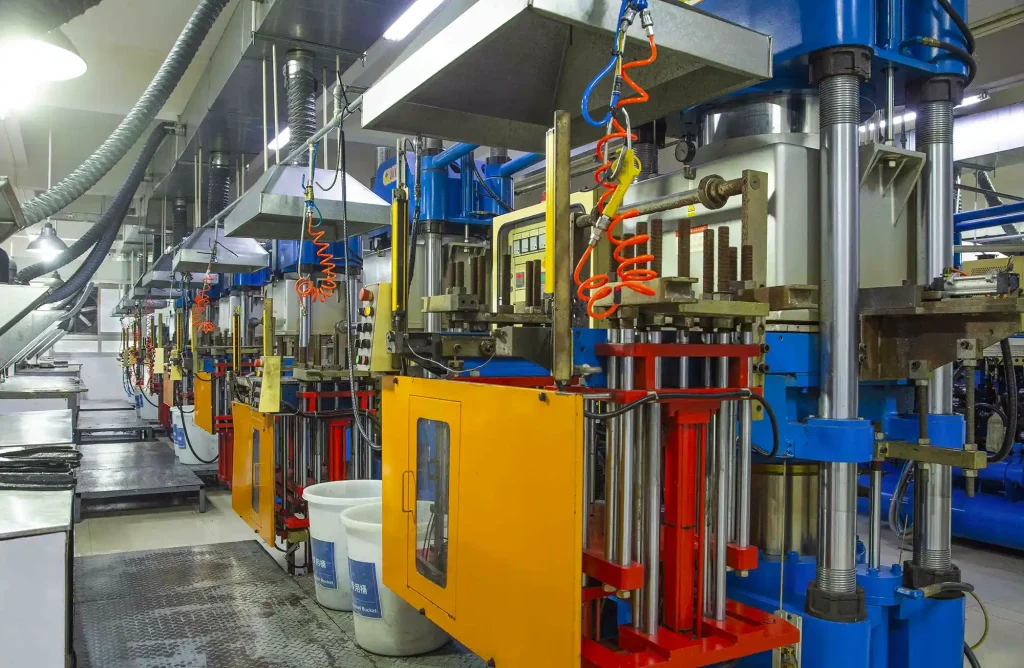
In compression molding, a preformed silicone blank is placed into a heated mold cavity. As the mold closes, the material flows in a controlled manner and fills the geometry of the part. At the same time, heat initiates vulcanization. Once the vulcanization process is complete, the mold is opened and the finished component is removed.
Modern production typically uses multi-cavity tools, enabling several components to be manufactured during a single production cycle. Cycle time depends on the material, wall thickness, and geometry, but is typically in the range of a few minutes. This is why compression molding is suitable not only for prototypes and smaller batches, but also for medium and high-volume production.
Tooling Design
In compression mold design, attention is paid to material flow direction, venting, parting line location, part release, and production capacity. A well-designed tool fills evenly, minimizes trapped air within the component, and enables consistent quality throughout the tool’s service life.
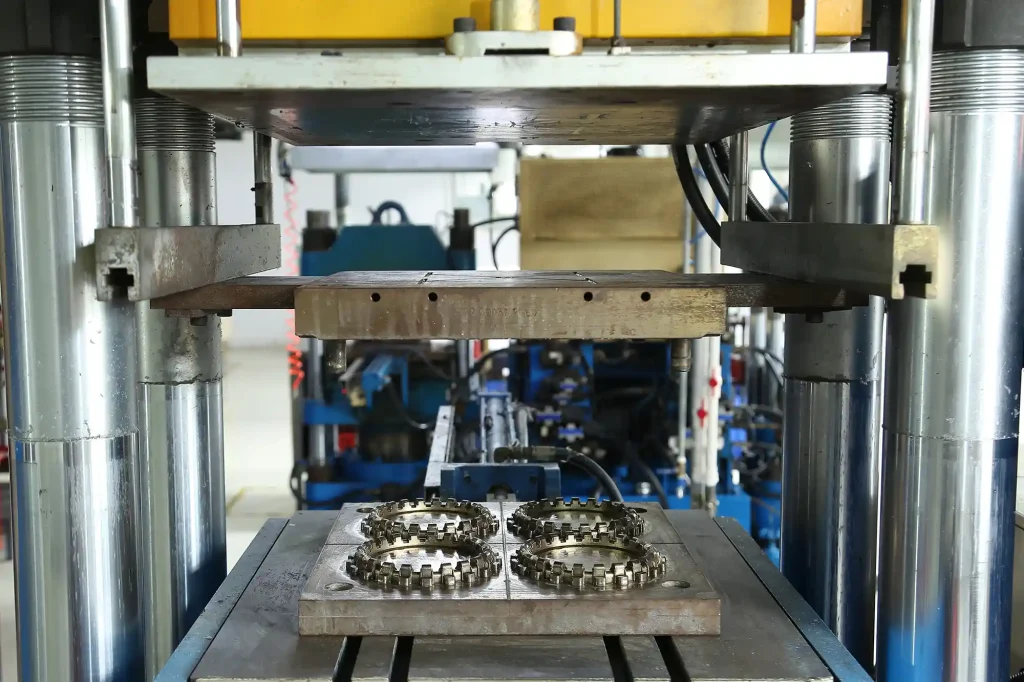
A multi-cavity tool can significantly increase production capacity without the need to move to another manufacturing method. The number of cavities is defined based on production volume, part size, and the capacity of the compression press.
Design for Manufacturing
A significant share of the manufacturing cost of a silicone component is determined already during the design phase. The location of the parting line, uniform wall thicknesses, realistic tolerances, and material selection all affect the tool structure and the efficiency of production.
Silicone shrinks during vulcanization, which means material-specific shrinkage must be considered in tool dimensioning. Final optimization is carried out based on measurements of the first trial parts. Critical dimensions should therefore be identified already during the quotation phase so that the tool can be optimized accordingly.
Post-Curing
Not all products require post-curing, but in demanding applications it is often an essential part of the manufacturing process. Heat treatment reduces volatile compounds and can improve long-term material durability, heat resistance, and suitability for medical and food-contact applications according to the customer’s requirements.
When Should Transfer Molding or LSR Be Considered?
In transfer molding, the material is pressed into the mold cavities through a separate transfer chamber. The method is particularly suitable for products in which metallic or electronic inserts are integrated inside the silicone. Gelecta’s manufacturing network has experience with such solutions, including components for medical devices.
LSR injection molding, on the other hand, offers a high level of automation and excellent repeatability in large production volumes. However, the tooling investment is generally higher than in compression molding, which is why the manufacturing method should always be selected based on the overall economics of the project.
Summary
Compression molding remains one of the most important manufacturing methods for silicone components. When designed correctly, it offers a competitive combination of tooling cost, quality, flexibility, and production capacity. Every project is different, however, which means the manufacturing method should be selected based on the product geometry, material requirements, annual volume, and quality requirements.
Gelecta helps customers evaluate the manufacturability of silicone components already during the product development phase. Through our certified manufacturing network, we can offer solutions based on compression molding, transfer molding, and LSR injection molding, as well as support with tooling design and Design for Manufacturing optimization.